The Real Truth: Hisense U8N vs. TCL QM7 QD-Mini LED TV
The mid-range television market has undergone a dramatic transformation over the last few years. What used to be a category defined by compromise is now the primary battleground for cutting-edge display technology. For 2024 and 2025, two titans have emerged to define this segment: the Hisense U8N (the successor to the acclaimed U8H and U8K series) and the TCL QM7 (the latest iteration of their high-performance QD-Mini LED lineup). While enthusiasts often look toward flagship models costing thousands more, the savvy consumer is increasingly finding that these two series offer roughly ninety-five percent of the performance at a fraction of the cost.
Choosing between Hisense and TCL is no longer a matter of picking the "budget" option. Both brands have invested billions into research and development, specifically focusing on Mini LED backlighting and Quantum Dot color enhancement. However, they approach the "perfect picture" from slightly different philosophical angles. Hisense often prioritizes raw luminance and aggressive processing, while TCL frequently leans into contrast control and local dimming precision. This article provides a deep dive into the technical specifications, real-world performance, and long-term value propositions of both the Hisense U8N and the TCL QM7 to help you decide which deserves the center spot in your living room.
The Evolution of Mini LED and Quantum Dots
To understand why these two TVs are so highly regarded, one must understand the technology driving them. Both the Hisense U8N and the TCL QM7 utilize Mini LED backlighting. Traditional LED TVs use a relatively small number of large light-emitting diodes to illuminate the screen. Mini LEDs, as the name suggests, are significantly smaller—often less than 0.2mm. This allows manufacturers to pack thousands of these tiny lights behind the LCD panel, grouped into hundreds or even thousands of independent "local dimming zones."
The result of this density is twofold: higher peak brightness and better black levels. When a scene requires total darkness in one corner and a bright explosion in the center, a Mini LED TV can turn off the LEDs in the dark area while pushing the center LEDs to their limit. Coupled with a Quantum Dot layer—microscopic crystals that emit specific colors when hit by light—these TVs produce a "QD-Mini LED" picture that rivals the color saturation and contrast of OLED panels, without the risk of permanent burn-in or the relatively lower brightness levels associated with organic light-emitting diodes.
Detailed Analysis: Hisense U8N
The Hisense U8N arrives as a statement piece. Hisense has gained a reputation for "spec-padding" in the best way possible, offering hardware features that normally belong in the "Master Series" of legacy brands. The U8N is built around the Hi-View Engine Pro, a sophisticated AI processor designed to handle upscaling, motion smoothing, and, most importantly, the complex algorithms required to manage its massive zone count.
One of the standout features of the U8N is its peak brightness. In many laboratory tests and real-world HDR scenarios, the U8N can eclipse 3,000 nits. To put that in perspective, a standard bright office is roughly 300 to 500 nits. This massive "headroom" allows the U8N to render specular highlights—the glint of sun on water, the glow of a lightsaber, or the intensity of a flashlight—with a startling realism that feels almost three-dimensional. For rooms with significant ambient light or large windows, the U8N is virtually peerless in its price bracket.
However, raw power requires control. The U8N uses a high-density Mini LED structure that minimizes "blooming" (the hazy glow sometimes seen around white text on a black background). Hisense has also improved its "Game Bar" and connectivity, offering 144Hz refresh rates and full support for G-Sync and FreeSync, making it a favorite for PC gamers who want a giant monitor experience.
Pros and Cons of the Hisense U8N
- Pros: Industry-leading peak brightness that handles bright rooms with ease and makes HDR content truly "pop."
- Pros: High local dimming zone count resulting in deep, ink-like blacks and excellent contrast.
- Pros: Advanced gaming features including 144Hz native refresh rate and low latency modes.
- Pros: Robust built-in sound system with a dedicated subwoofer for better-than-average integrated audio.
- Cons: Viewing angles remain somewhat narrow due to the VA-style panel, leading to color shift when sitting far off-center.
- Cons: Processing can occasionally be over-aggressive, leading to "black crush" where shadow details are lost in favor of deeper blacks.
- Cons: The software interface (Google TV) is feature-rich but can feel slightly sluggish compared to dedicated streaming sticks.
Detailed Analysis: TCL QM7
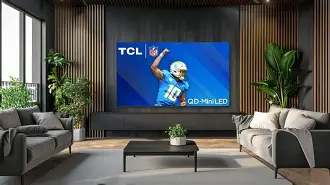
TCL is the company that arguably pioneered the commercialization of Mini LED, and the QM7 represents their "sweet spot" for the current market. While TCL offers a higher-end QM8, the QM7 is designed for the buyer who wants high-end performance without crossing the thousand-dollar threshold for mid-sized units. The QM7 utilizes the AIPQ Pro Processor, which focuses heavily on color accuracy and "natural" tone mapping.
The TCL QM7 might not hit the same stratospheric brightness numbers as the Hisense U8N, but it counters with exceptional local dimming logic. TCL has spent years refining how its zones react to fast-moving objects. In sports and action movies, the QM7 excels at keeping the backlight in sync with the on-screen movement, reducing the "trailing" effect that can plague lower-end Mini LED sets. Its color reproduction is vibrant yet grounded, avoiding the "neon" look that sometimes occurs with over-saturated Quantum Dot panels.
Discover deals on TVs & Home Theater — updated daily.
Shop Amazon →A key advantage for the QM7 is its build quality and aesthetic. With a slim profile and a centered pedestal stand (on most sizes), it fits more easily on narrower media consoles than the wide-set feet found on many competitors. For gamers, TCL has included the "Game Master" suite, which provides a dedicated dashboard to monitor frames per second and adjust shadow detail on the fly. While it matches most of Hisense's gaming specs, users often report that TCL’s implementation of Variable Refresh Rate (VRR) is slightly more stable across different GPU architectures.
Pros and Cons of the TCL QM7
- Pros: Excellent value-to-performance ratio, often priced lower than the Hisense equivalent during sales.
- Pros: Precise local dimming algorithms that virtually eliminate blooming in all but the harshest conditions.
- Pros: Great out-of-the-box color accuracy in "Movie" or "Filmmaker" modes, requiring less calibration.
- Pros: Versatile design with a central stand that accommodates various furniture types.
- Cons: Peak brightness, while high, is measurably lower than the U8N, making it slightly less effective in extremely sunny rooms.
- Cons: Built-in speakers are adequate for dialogue but lack the low-end punch found in the Hisense U8N.
- Cons: Occasional "dirty screen effect" (DSE) can be present on very large panels, though this varies by individual unit.
Side-by-Side Comparison
Comparing these two models involves looking past the marketing jargon and examining the core metrics that affect daily viewing. Below is a breakdown of how these two televisions compare across the most critical categories for modern buyers.
| Feature | Hisense U8N | TCL QM7 |
|---|---|---|
| Backlight Tech | Mini LED (High Density) | QD-Mini LED |
| Peak Brightness | Up to 3,000+ Nits | Up to 2,000 Nits |
| Processor | Hi-View Engine Pro | AIPQ Pro Processor |
| Refresh Rate | 144Hz Native | 144Hz Native |
| HDR Formats | Dolby Vision IQ, HDR10+, HLG | Dolby Vision IQ, HDR10+, HLG |
| Smart Platform | Google TV | Google TV |
| Audio | 2.1.2 Multi-Channel (Built-in Sub) | 2.1 Channel (Onkyo tuned) |
| Primary Strength | Raw Brightness & Specular HDR | Balanced Precision & Color Accuracy |
The Buying Guide: Which One Is Best for You?
Because these TVs are so closely matched, the "correct" choice depends almost entirely on your specific environment and what you plan to watch. Here are the real-world use cases that should influence your final decision.
Case 1: The Sun-Drenched Living Room
If your television is placed opposite a large window or under bright recessed lighting, the Hisense U8N is the clear winner. Its ability to push three thousand nits of brightness is not just about making the sun look bright in a movie; it is about overcoming the physical reflection of light in your room. The U8N also features a slightly better anti-reflective coating that helps diffuse ambient light, ensuring that you don't spend your Sunday afternoon football game looking at a reflection of your own sofa.
Case 2: The Dark Room Cinema Experience
For those who do their primary viewing in a basement, a bedroom, or a dedicated media room with blackout curtains, the TCL QM7 holds a slight edge. In a dark room, excessive brightness can actually be fatiguing to the eyes. The TCL focuses its energy on "near-black" performance—the ability to show detail in the folds of a dark coat or the shadows of a dark alleyway. Its local dimming is tuned for subtlety, which creates a more filmic and immersive experience when the lights go down.
Case 3: The Hardcore Gamer
If you own a PlayStation 5, Xbox Series X, or a high-end gaming PC, you will be happy with either. Both support 4K at 120Hz (and up to 144Hz for PC). However, the Hisense U8N’s higher brightness can make games using Auto-HDR or specialized HDR modes look incredibly vibrant. Conversely, the TCL QM7 is often praised for its "Game Master" UI, which allows for easier adjustments without backing out of the game. If you play competitive shooters where every millisecond matters, TCL’s history of slightly lower input lag might give you the confidence you need.
Case 4: The Budget-Conscious Tech Enthusiast
Prices fluctuate throughout the year, but generally, the TCL QM7 is positioned slightly lower in price than the Hisense U8N. If you are looking to maximize screen size—moving from a 65-inch to a 75-inch or 85-inch model—the cost savings with the TCL can be significant. For many buyers, the difference in brightness between the two won't be as noticeable as the difference between a 65-inch and a 75-inch screen in their living room.
Advanced Considerations: Processing and Motion
One area where premium brands like Sony or Samsung traditionally held an advantage was in motion processing and upscaling. However, 2024 mark a turning point for both Hisense and TCL. The Hisense Hi-View Engine Pro has made leaps in how it handles low-resolution content. If you watch a lot of local news or older sitcoms on cable TV (usually 720p or 1080i), the Hisense does a commendable job of sharpening those images without making them look "waxy."
Looking for the best TVs & Home Theater deals on Amazon?
View Offers →TCL’s AIPQ Pro Processor focuses more on "AI Color" and "AI Motion." For sports fans, this is critical. When a football or hockey puck moves rapidly across the screen, a processor must decide how to fill in the gaps between frames. TCL’s motion handling tends to be more conservative, avoiding the "Soap Opera Effect" (where movies look like home videos) while still maintaining clarity during fast action. It’s a delicate balance that TCL strikes with impressive maturity.
Longevity and Brand Reliability
A common concern for buyers moving away from "legacy" brands is reliability. Both Hisense and TCL have matured significantly in this regard. They now offer robust warranty support and have massive manufacturing footprints. In terms of software, both utilize Google TV, which is currently the most supported smart platform in the world. This means you’ll get updates for apps like Netflix, Disney+, and YouTube for years to come. Both sets also support ATSC 3.0 (NextGen TV) tuners in most regions, ensuring that you are future-proofed for over-the-air 4K broadcasts as they become more common.
Final Thoughts
The "Real Truth" is that we have reached a point where there are no losers in this comparison. Whether you choose the Hisense U8N or the TCL QM7, you are purchasing a television that would have cost five thousand dollars only four years ago. You are getting the benefits of Mini LED’s incredible contrast and the vibrant color palette provided by Quantum Dots.
If you value raw power, blistering brightness, and an integrated sound system that can actually shake the room, the Hisense U8N is your champion. It is a technological tour-de-force that demands attention and performs exceptionally well in bright, modern homes. It is the "muscle car" of the television world—bold, powerful, and packed with every feature imaginable.
If you prefer a more balanced approach, where precision, color accuracy, and value for money take center stage, the TCL QM7 is the smarter pick. It offers a refined viewing experience that respects the director's intent, providing a high-end cinematic feel without the high-end price tag. It is the "sports sedan"—agile, sophisticated, and perfectly tuned for the driver who knows exactly what they want from the experience.
Before making your final purchase, consider your room's lighting and your primary content. If you can find the Hisense on a significant sale, its brightness advantage makes it hard to pass up. If the TCL allows you to size up within your budget, the extra screen real estate will almost always provide a more impactful upgrade than a few hundred extra nits of brightness. Either way, the new era of Mini LED has arrived, and it is more accessible than ever.